
Agricultural output likely shrank in Q1

Agricultural output likely shrank in Q1

By Vonn Andrei E. Villamiel, Reporter

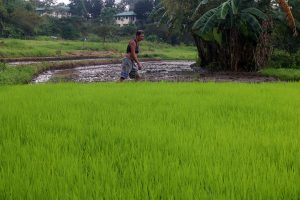
THE PHILIPPINES’ agricultural output likely contracted in the first quarter of 2026, weighed down by a drop in major crops such as rice, and continued weakness in fisheries and livestock subsectors, analysts said.


Former Agriculture Secretary William D. Dar told BusinessWorld that he expects farm sector output to shrink by about 3% in the January-to-March period. If this projection is realized, it will be a reversal from the 2% growth recorded in the same period last year.

“For the first quarter of 2026, there will be a decline of about 3% compared to the first quarter of 2025. Livestock and fisheries are always declining,” Mr. Dar said in a Viber message.

The Philippine Statistics Authority (PSA) is set to release the first-quarter agriculture output data on May 6, a day ahead of the gross domestic product (GDP) data. Agriculture contributes about a tenth to the Philippines’ GDP and roughly a quarter of total employment.

Raul Q. Montemayor, national manager of the Federation of Free Farmers, told BusinessWorld that the projected decline in agricultural output was largely driven by lower rice output, which accounts for roughly 30% to 40% of the total crop production by value.

In a report on Thursday, the PSA said palay (unmilled rice) production fell by 6.26% to a six-year low of 4.4 million metric tons (MT) in the first quarter from 4.7 million MT a year earlier.

Mr. Montemayor said weak farmgate prices in the latter half of 2025 have dampened farmers’ incentive to plant, contributing to the lower harvest.

“The palay harvested in the first quarter of 2026 was planted in the last quarter of 2025, during which time palay prices were severely depressed, even with the import ban,” he said.

Danilo V. Fausto, president of the Philippine Chamber of Agriculture and Food, Inc., said the country’s farm output was also affected by damage to a major irrigation system in Nueva Ecija late last year.

He said the disruption affected about 30,000 to 40,000 hectares of farmland in the country’s top rice-producing province.

“While the National Irrigation Administration tried to catch up on the repair, recovery of the planted areas affected by a lack of irrigation will be delayed, pushing the harvesting of palay to the second quarter,” he earlier told BusinessWorld.

Meanwhile, Mr. Dar also cited delayed distribution of seeds and fertilizers, uneven government support across subsectors, and weak mobilization of extension services as additional factors that may have dampened first-quarter output.

HOG SECTOR RECOVERY
Meanwhile, Alfred Ng, vice chairman of the National Federation of Hog Raisers, said that despite weak livestock performance in the first quarter, the hog industry may see improvements in the coming quarters.

Production continues to be affected by the African Swine Fever, he said, but government support is expected to aid recovery.

“Since the Department of Agriculture (DA) has given a budget of P1.6 billion for repopulation this year, hog production will certainly be expected to go up soon,” Mr. Ng told BusinessWorld via Viber.

He said the budget could fund the procurement of 40,000 gilts, potentially adding 29 million kilos of pork annually.

Mr. Ng also cited Republic Act No. 12308, or the Animal Industry Development and Competitiveness Act, enacted last year, as a key measure supporting the sector’s rebound.

Hog production accounts for about 80% of total livestock output by value. In 2025, hog production was estimated at P246.42 billion, the lowest level since the P189.57 billion recorded in 2001, based on PSA data.

FULL-YEAR CONTRACTION
Analysts warned that the agriculture sector may face continued challenges for the rest of the year, raising the risk of a full-year contraction.

“[There are] tremendous headwinds we will be facing in the next three quarters of this year, such as high fertilizer prices, fuel and transport costs, and a possible severe El Niño,” Former Agriculture Undersecretary Fermin D. Adriano told BusinessWorld via Viber.

Agriculture output had expanded by 2.6% in 2025, the fastest pace in eight years, mainly due to gains in crop output and a strong poultry performance.

The DA earlier said palay output could dip to about 18.6 million MT to 18.8 million MT if the prices of fuel and key agricultural inputs, particularly fertilizer, remain elevated through the next cropping season.

If production falls to 18.6 million MT, this would be the lowest palay output since the 17.62 million MT recorded in 2016.

The DA said it is also closely monitoring the potential impact of the developing El Niño, which could further reduce yields in the coming months.

In 2024, farm output contracted by 2.1% when the agriculture sector was affected by drought and dry spells caused by the El Niño which began in June 2023.

In a statement on Wednesday, the agency added that it is coordinating with regional offices and other relevant agencies to assess vulnerabilities and deploy early interventions ahead of the developing El Niño.

The DA said measures include prepositioning inputs such as drought-tolerant seed and assessing irrigation systems in major service areas to anticipate potential water shortages and adjust allocation schedules.

Agriculture Assistant Secretary Arnel V. de Mesa told reporters on April 21 that palay output losses for the second cropping season could reach 20% in a best-case scenario and up to 50% in a worst-case scenario.

To mitigate risks, the DA said it is exploring the use of biofertilizers as a cost-effective alternative to fuel-based inputs.

Mr. de Mesa said P500 million of the DA’s P1-billion Quick Response Fund, activated following the declaration of the state of national energy emergency, will be used to procure biofertilizers ahead of the next cropping season.