
Oil shock to bring inflation above 4%
 Tomas Kauer - News Moderator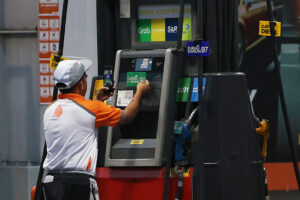
By Kenneth Christiane L. Basilio, Reporter
THE IRAN war could trim 0.2-0.3% from the Philippines’ gross domestic product (GDP) growth this year, as the oil shock could drive inflation to above 4% this year, Department of Economy, Planning, and Development (DEPDev) Secretary Arsenio M. Balisacan said on Tuesday,
At the same time, the House Ways and Means Committee passed a proposal authorizing President Ferdinand R. Marcos, Jr. to suspend excise taxes on fuel products, advancing a proposal aimed at cushioning the impact of volatile oil prices on consumers.
“The suspension of excise taxes… could reduce the inflationary effects of oil prices and global oil price escalation,” Mr. Balisacan told lawmakers at a congressional hearing. “Oil prices affect practically all goods and services produced in this economy, so the effect is considerable.”
He said the soaring pump prices will stoke inflation, eroding Filipinos’ purchasing power and weighing on economic activity.
As a net importer of oil, the Philippines is highly sensitive to sharp fluctuations in global oil prices.
While fuel retailers agreed to stagger this week’s big-time price adjustments, the surging prices risk reigniting inflation.
According to its baseline scenario presented to the House Energy Committee, the DEPDev projected inflation could quicken to 4.5-5.1% this month, and 4.5-4.8% in April, with full-year inflation seen settling at 4-4.2%, above the central bank’s target band.
In a worst-case scenario where oil prices hit $140 this month and stay above $80 until September, DEPDev said inflation could accelerate to 6.3-7.5% in March and 6.4-7.5% in April, bringing the full-year print to 4.5-4.8%.
Inflation could settle at 3.5-3.6% in 2027 under its baseline scenario, and at 3.6-3.7% under the second scenario, according to DEPDev’s presentation.
“With this kind of inflation, if you don’t do anything, that’s going to hit hard the consumers and substantially reduce household consumption spending, affecting our economy,” Mr. Balisacan said.
Unchecked inflation could drag the country’s full-year growth “back below 5%,” he said, adding that the Development Budget Coordination Committee is still targeting 2026 growth of 5-6% and 5.5-6.5% for 2027.
“We are assessing the situation when the new number comes in May. But with the impact we are seeing, that could push us back below 5%,” he said.
Philippine GDP growth slowed to 4.4% in 2025, the slowest in five years, as the flood control scandal weighed on government spending, investments and consumer spending.
EXCISE TAX SUSPENSION
Mr. Balisacan said the economic impact of continuous increases in gas prices could be tempered by suspending excise taxes, which would help ease the burden on consumers.
“A temporary suspension of excise tax collections could restore part of the purchasing power,” he said.
The House Ways and Means Committee on Tuesday approved an unnumbered consolidated bill that would give the President special powers to suspend or reduce excise taxes of petrol during national and global emergencies for no more than six months.
Any suspension or cut in the fuel excise tax rate could be extended beyond six months through a joint congressional resolution.
Any extension cannot last longer than a year, according to Ways and Means Committee Chair and Marikina Rep. Romero “Miro” S. Quimbo.
He said the bill also requires the President to submit to Congress a report backing his decision to cut the excise tax, including estimates of foregone revenue and the impact on inflation, fuel prices and economic activity.
“We are dependent on the international market. Whatever happens there, we do not have leverage,” Mr. Quimbo told reporters. “The only thing that we can leverage to reduce fuel prices is by removing excise taxes.”
Moves to suspend the collection of petrol duties have gained traction in Congress after successive fuel price hikes that will likely drive consumer prices higher.
The Philippine Chamber of Commerce and Industry (PCCI) said it supported efforts to empower Mr. Marcos “to implement measures that will absorb and stabilize prices” amid fuel hikes.
“Our request to government is to absorb temporarily the fuel price increases,” PCCI President Perry A. Ferrer said in a statement. “Hopefully, the President will be given the authority to exercise and use other means that will help cushion potential shocks this week or next week.”
A 2017 law previously allowed the government to suspend the collection of excise tax on petroleum products when world oil prices reach $80 per barrel for three straight months, but the provision lapsed six years ago.
Mr. Balisacan said revenue losses from the suspension of excise taxes on petrol could reach P43.3 billion if the suspension lasts three months, and P106 billion if extended until September.
“If you suspend excise taxes, that would mean less revenue collection for the government. That would impact our projects and programs and mean less fiscal resources,” he said.
Projections from the Department of Finance showed suspending excise tax collections could lead to P136 billion in foregone revenue, which the department said could widen the government’s budget deficit and raise the country’s debt.
“While the effects on the revenue is quite a bit, the net effect on the economy of not doing anything about it is even worse,” said Mr. Balisacan.
Temporarily halting excise tax collections on fuel products could lead to cheaper fuel and ease inflation, he added.
According to the DEPDev, suspending excise taxes from March to May could help inflation ease to 3.6-4.2% in March and 3.6-3.9% in April. This could bring full-year inflation at 3.9-4.1% by end-2026, under the baseline scenario.
On the other hand, if global prices remain elevated and excise taxes are suspended from March to September, inflation could settle at 5.4-6.6% in March and 5.5-6.5% in April, with full-year inflation at 4.-4.3%.
For 2027, DEPDev sees inflation settling at 3.5-3.6% under the baseline scenario, and 3.6-3.7% under the worst-case scenario.
DEPLOYMENT BAN?
Mr. Balisacan said remittances from overseas Filipino workers (OFWs) could also be affected if the government decides to impose a ban on deployment to the Middle East.
The local economy could lose between P226.6 billion and P232 billion if about 550,000 Filipinos are repatriated, he said.
“If you assume a total deployment ban… this reduction represents about 65% of the remittances from the region,” he said. “It’s quite a significant impact on our OFWs… and also the economy.”
There are an estimated 2.41 million Filipinos in Middle Eastern countries. More than 975,000 are stationed in the United Arab Emirates, while others are in Saudi Arabia (813,000), Qatar (250,000), and Kuwait (211,000). There are about 800 Filipinos in Iran and 31,000 in Israel, according to data from the Foreign Affairs department.