
Big-time fuel price hikes set as war throttles supply
 Tomas Kauer - News Moderator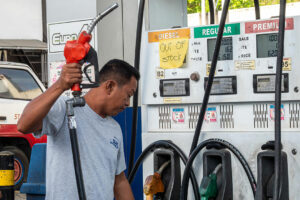
By Sheldeen Joy Talavera, Reporter
SEVERAL OIL COMPANIES have agreed to spread out this week’s increases in fuel costs to temper the big-time adjustments reaching as much as P38.50 per liter as a widening war in the Middle East continues to threaten oil supply, driving up global prices.
Motorists should brace for a sharp spike in pump prices starting on Tuesday, March 10, ranging from P7 to P38.50 per liter, data from the Department of Energy (DoE) showed. Gasoline prices are set to increase by P7 to P13 per liter, diesel prices will rise by P17.50 to P24.25 per liter, while kerosene is expected to go up by P32 to P38.50 per liter.
The hikes will result in pump prices ranging from P53.10-P73.40 per liter for gasoline, P63-P87.44 per liter for diesel, and P92.17-P125.17 per liter for kerosene.
At a press briefing on Monday, Energy Secretary Sharon S. Garin said several oil companies agreed to stagger the implementation of increases instead of imposing one-time hikes. This is as Energy Undersecretary Alessandro O. Sales said that this week’s price increases would be “the largest single-week adjustment” in fuel costs.
Some of the major oil companies that will implement a gradual rollout of price hikes over periods of two to seven days are Shell Pilipinas Corp.; Petron Corp.; Total (Philippines) Corp.; Chevron Philippines, Inc.; Jetti Petroleum, Inc.; and Seaoil Philippines, Inc.
Seaoil and Total will split the increases in gasoline and diesel prices over March 10-11, while Shell and Petron will implement a three-day rollout of increases.
For its part, Jetti implemented a staggered increase in gasoline and diesel prices as early as March 8, which will continue until March 13, as acknowledged by the DoE.
Meanwhile, Chevron will have the slowest movement in price adjustments as it plans to spread the increases from March 10-16.
Fuel retailers have implemented several rounds of price increases this year as global oil prices continue to climb. This week’s price adjustments mark the 11th consecutive weekly increase for diesel and kerosene prices and the ninth straight week for gasoline.
“We do not dictate the companies what price they will charge the public. What DoE can do is monitor and have them explain why their prices are like that, but we cannot impose in that sense,” Ms. Garin said.
Under the revised guidelines for the monitoring of prices in the sale of petroleum products issued by the DoE in 2019, price adjustments for liquid fuel should be implemented beginning every Tuesday of the week.
The DoE has flagged several fuel stations for allegedly implementing unscheduled or unauthorized price adjustments. Of over 80 reports reviewed, Ms. Garin said the department will issue 55 show-cause orders to the fuel stations.
“(We are) giving them 24 hours to answer DoE if there is a valid reason not to cancel their permits,” she said.
Fuel shipments are currently disrupted following the closure of the Strait of Hormuz, where about 20% of the world’s oil and liquefied natural gas pass through, amid the conflict involving Iran, the United States, and Israel.
As a net importer of crude oil, the Philippines is vulnerable to global crude price swings, which geopolitical tensions often trigger. Around 98% of Philippine crude imports come from the Middle East. The remaining 2% is sourced from Brunei and Malaysia.
Ms. Garin assured the public that the country has enough supply until the end of April and enough time to order for more.
Currently, oil companies are required to maintain at least a 30-day inventory of crude oil and a 15-day inventory of finished petroleum products.
The Energy chief said that some fuel retailers have secured enough stockpile that could cover 50 days of consumption.
Mr. Sales added that the DoE is currently monitoring the threshold level of Dubai crude prices, as hitting $80 per barrel over a period of one month would trigger the release of fuel subsidies allocated for various beneficiaries.
“As per our calculation, the average 30-day is close to $75 per barrel already. So, we’re keeping a watch on this,” he said.
FUEL PRICE CAP?
Meanwhile, asked if the Philippines can cap prices as a relief measure, Ms. Garin said Republic Act No. 8479, or the Oil Deregulation Law, which liberalized the country’s downstream oil industry, prevents them from doing this.
“We are constrained by the law and the deregulation that we do not have the power to control the prices, unless maybe they give us authority or an amendment of the law or emergency powers,” she said.
Enacted in 1998, the law allows oil companies to set and adjust pump prices based on global oil prices and other market factors, instead of awaiting government approval. It aims to promote competition among oil companies and ensure adequate and continuous supply of petroleum products.
Ms. Garin said the department is open to discuss with the Congress any potential amendments to the law.
“If there’s a change, then I think it would be a welcome change also for us to be able to scrutinize more how the prices are computed and if we should limit or make a uniform pricing. That’s something that they can discuss and consider,” she said.
This, as governments in Asia are scrambling to limit the impact on economies and consumers from the widening Iran war, which fueled a record surge in oil prices on Monday after key producers cut output and Tehran signaled that hardliners will remain in charge, Reuters reported.
In South Korea, which buys 70% of its oil from the Middle East, President Lee Jae Myung said Seoul would cap fuel prices for the first time in nearly 30 years and warned against panic buying.
A senior Japanese parliament member said on Sunday that the government had instructed a national oil reserve storage site to prepare for a possible crude release, although the country’s chief Cabinet secretary said on Monday that no decision had been made to release stockpiles.
Elsewhere, Vietnam removed import tariffs on fuels and Bangladesh shut universities to conserve electricity and fuel, while China last week asked refiners to halt fuel exports and try to cancel shipments already committed.
Oil jumped 25%, with Brent on track for a record one-day gain, after Iran on Monday named Mojtaba Khamenei to succeed his father Ayatollah Ali Khamenei as supreme leader, while Organization of the Petroleum Exporting Countries producers Kuwait and Iraq cut oil output during the weekend as the crucial Strait of Hormuz remained effectively shut. — with Reuters