
DBM prefers 3% cap for unprogrammed appropriations
 Tomas Kauer - News Moderator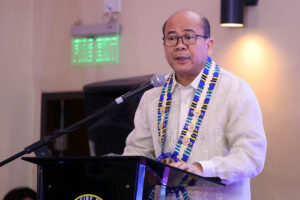
By Justine Irish D. Tabile, Senior Reporter
THE DEPARTMENT of Budget and Management (DBM) is looking at lowering the cap on unprogrammed appropriations (UA) to as low as 3% of the national budget, its top official said.
“As much as possible, [I want it to be low]. Because that is one of the issues that was raised not only in the budget preparation but also in the deliberation in the legislation process,” Budget Secretary Rolando U. Toledo told reporters on the sidelines of an event on Tuesday.
“I myself, I can go lower by 3%, probably not just 5% just to minimize, of course, our UA level,” he added.
Last year, then-Budget Secretary Amenah F. Pangandaman proposed a 5% cap on UAs to serve as an allowance for unforeseen spending needs. This was, however, called “excessive” by former Finance Secretary Ralph G. Recto, now executive secretary, who has proposed a cap of 2% of the national budget.
However, Mr. Toledo said limiting the cap for UA is still subject to congressional approval.
To make this happen, the department seeks the passage of the proposed Philippine Budgeting Code, or the Progressive Budgeting for Better and Modernized Governance bill, which is among the Legislative-Executive Development Advisory Council’s common legislative agenda for the 20th Congress.
Mr. Toledo said that he is hopeful that the provisions of the bill will cover budget preparation, execution, accountability, and monitoring.
“What we also want to emphasize here is citizens’ participation in the budget process. That is what we want to have there in our Philippine Budgeting Code,” he said.
Mr. Toledo said the DBM is looking forward to the inclusion of a mandated calendar for budget preparation, execution, and accountability to prevent delays in the budget calendar.
“The Philippine Budgeting Code actually just institutionalizes what we are now implementing and the reforms that we want to do,” he added.
UAs have been the subject of public scrutiny as the country tackles corruption scandals involving public infrastructure projects, particularly those involved in flood control.
Mr. Toledo said that the lack of flood control projects is the reason for the 15% drop in climate funding to P983 billion this year, from P1.16 trillion in 2025.
“Understandably, because a big part of our climate funding is through flood control. We don’t have flood control projects now, that’s why it is understandable that our budget for climate-related funding has decreased,” he said in a mix of Filipino and English.
Asked if he expects climate funding to rebound in 2027, Mr. Toledo said that it will “depend on the submission of the budget of the different department agencies.”
GlobalSource Principal Advisor Diwa C. Guinigundo said that more than setting a cap, the Philippine government should define what can be included in unprogrammed appropriations.
“It’s not a matter of setting up some kind of a threshold. Define first what needs to be included in the UAs,” he said in a Viber message.
“If this is about pork barrel parading as critical infrastructure, by all means delete it from the list even as the aggregate remains below a certain threshold like 3%,” he added.
RELEASE RATE
For the first quarter, the DBM is targeting to disburse around P1.4 trillion, after the budget release rate hit 62.2% by the end of January.
“We have a target. We’re looking at around P1.4 trillion (programmed)… That is our disbursement target for the first quarter,” said Mr. Toledo.
“That is a higher target compared with the previous year. It is really to help boost the economy and to rebound from the fourth quarter,” he added.
In January, the DBM disbursed P4.25 trillion out of the P6.794-trillion budget for the year.
“We only released the comprehensive operational requirements of the agency. So right now, we’re still receiving requests for the additional funding for their payables for the prior years, at the same time, the additional requirements for the quarter,” he said.
Mr. Toledo said that the DBM is being pushed to increase spending in the first quarter to boost the economy.
“We want to increase our spending in the first quarter so that we can recover from the fourth-quarter low disbursement that affected our growth, so we’re looking forward to increase their disbursement as far as the agencies are concerned,” he said.
“We’re just awaiting the submission of their request. Right now, we’re already receiving requests but we’re still in the process,” he added.
In 2025, the economy expanded by 4.4%, the weakest in five years, as the flood control scandal negatively affected government spending, investments and consumer spending.
In the fourth quarter of 2025, gross domestic product expanded by 3%, from 5.3% in the fourth quarter of 2024 and the revised 3.9% print in the third quarter of 2025. The slowdown came as a surprise as the fourth quarter is typically a strong period for growth due to holiday spending.