
BMI keeps 5.2% growth estimate
 Tomas Kauer - News Moderator
FITCH SOLUTIONS unit BMI has kept its 2026 growth forecast for the Philippines despite the last year’s miss as it expects public and private investments to recover.
BMI sees the Philippine economy expanding by 5.2% this year, unchanged from its earlier projection.
“For now, we are maintaining our 2026 growth forecast at 5.2%, but the lower 2025 base makes this a more pessimistic outlook,” it said in a report on Monday.
This is within the government’s 5%-6% growth target for the year.
Philippine gross domestic product (GDP) expanded by 3% in the fourth quarter, slower than 5.3% in the same period a year prior and the revised 3.9% print in the third quarter, the government reported last week.
This was the slowest quarterly print in nearly five years or since the 3.8% contraction in the first quarter of 2021. Outside of the coronavirus pandemic, this was the worst since the 1.8% growth recorded in the fourth quarter of 2009, or during the Global Financial Crisis.
This brought full-year 2025 GDP growth to 4.4%, below the government’s 5.5%-6.5% goal. This was slower than 2024’s 5.7% and was the weakest annual expansion since the 3.9% in 2011, counting out the 9.5% contraction in 2020 due to the pandemic.
Officials said tighter public spending and weak investor confidence due to the flood control scandal continued to drag growth.
BMI said it sees both public and private investments rebounding this year as the government works to ramp up spending and amid the lagged impact of the Bangko Sentral ng Pilipinas’ (BSP) past rate cuts on demand.
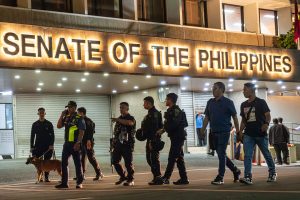
“The government probably underspent its capital budget in 2025… Beyond rhetoric from government officials pledging catch-up capital spending, we have not seen any indication of when the Senate investigation into corruption will conclude or when delayed infrastructure projects will be restarted,” it said.
“We would, however, be surprised if policymakers allowed the probe to drag on public capex (capital expenditure) for much longer — a quick recovery in infrastructure spending is necessary to hit the government’s 5-6% growth target for 2026. Our best guess for now is that the government will make up for the underspending of the capital budget in H2 (second half) 2026, with the low base flattering GDP growth in H2.”
It added that household consumption may also rebound this year, with the peso’s weakness to increase the value of remittances from migrant Filipinos.
However, the country’s external sector could weaken as last year’s export strength was largely driven by frontloading ahead of higher tariffs and increased electronics demand due to the artificial intelligence (AI) boom — which are both expected to lose steam this year, BMI said.
“Early indicators are starting to reflect deteriorating external orders… The global semiconductor upcycle appears to have peaked, as firms reassess the returns on AI-driven investments. This will materially affect electronic exports — about 54% of Philippine exports. Accordingly, we expect export growth to moderate as frontloading tapers and the higher 2025 base will mechanically make strong year-on-year growth hard to sustain,” it said.
“Should there be continued delays to infrastructure spending, household spending and exports will not be enough to offset weaker public spending, posing downside risks to our forecast. Inflation may also run hotter than we forecast if oil prices get another boost from rising geopolitical risks, limiting the BSP’s room for rate cuts.”
BMI expects the Monetary Board (MB) to deliver 50 basis points (bps) in cuts this year.
For its part, Deutsche Bank Research said the “surprise” growth slowdown last quarter increases the odds of a sixth straight rate cut by the BSP this month.
“We think that a February rate cut from the BSP is now almost certainly ‘on the table,’” it said in a report.
“We also see a rising likelihood of another rate cut in H1 (first half) given the likely wider-than-expected negative output gap,” it added “We will refresh our view pending more up-to-date data from 2026, including inflation, government disbursements, and BSP’s guidance in the February MB meeting.”
BSP Governor Eli M. Remolona, Jr. said on Sunday that a cut is possible at their Feb. 19 policy review if the fourth-quarter GDP slowdown proves demand-driven.
“If we can help on the demand side and still keep inflation low, then of course we’ll help,” he said.
He added that they will continue to assess the available data and decide “one meeting at a time.”
The Monetary Board has slashed benchmark borrowing costs by 200 bps since August 2024, bringing the policy rate to 4.5%. — Katherine K. Chan